A shading guide for Melkbosstrand written the way the village is actually laid out — as a walk inland from the water. Almost everything that decides a specification here weakens with every hundred metres you move back from the beach. One thing does not.
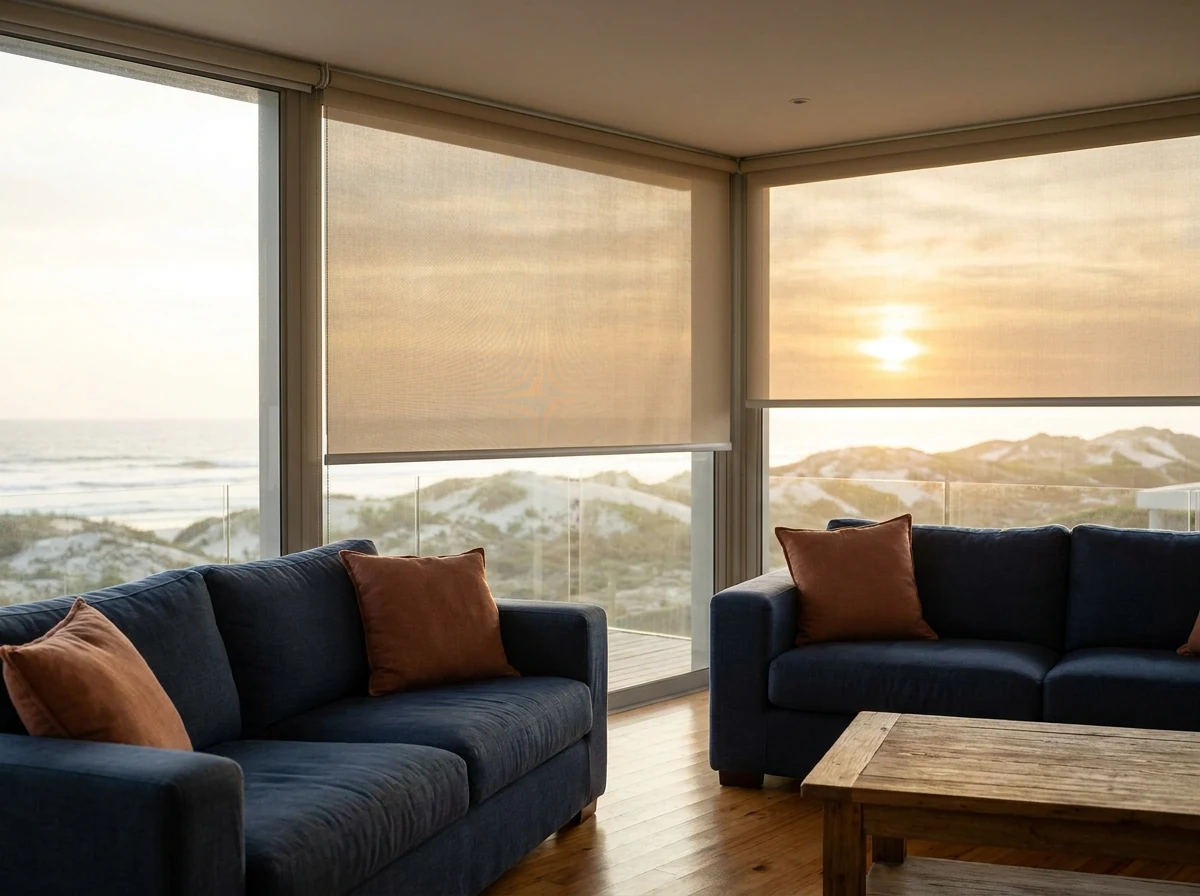
The evening the whole village is built toward — and the reason the same blind gets specified four streets inland.
Most shading advice treats a suburb as one thing. Melkbosstrand is not one thing — it is a narrow band of houses laid along seven kilometres of beach, and the difference between a front-row deck and a street four rows inland is bigger than the difference between two suburbs elsewhere in Cape Town.1 Nothing here is guessed: every figure is either sourced at the foot of the page or derived from the geometry.
01
Why there is so much room here
Melkbosstrand lies about thirty kilometres north of Cape Town, between Bloubergstrand to the south and Atlantis inland to the north-east, with roughly seven kilometres of white sand in front of it.1 The census main place covering the village runs to about 35.6 square kilometres and holds a population of a little over eleven and a half thousand.1 That is a strikingly low figure for a Cape Town suburb, and the reason is not shyness about building: a nature-conservation area sits to the south and a further buffer zone to the north, so a great deal of the ground inside that boundary was never available to develop in the first place.1
Open ground is pleasant to live in and inconvenient to specify for, because a neighbour's house is a piece of shading equipment. In a dense street the building opposite blocks the low sun, breaks the wind before it reaches your deck, and stops anyone seeing into your bedroom. Melkbosstrand hands you far less of all three. The wind arrives with a long clean run behind it, the low sun reaches windows that would be in shadow in a tighter suburb, and privacy stops being about the neighbours and starts being about the beach path and the road.
The Blouberg hill rises inland to the east, so this is not flat ground in every direction — but between the front row of houses and the water there is nothing at all.1
02
The one thing distance does not fix
Move four streets back and the salt load drops, the blown sand drops, the wind drops. The sun does not move a millimetre. Melkbosstrand sits at roughly 33.72° south,1 and from that latitude with the earth's 23.4° tilt the arc works out like this — calculated from the geometry rather than read off a local instrument:
At the December solstice the noon sun stands about 80° above the horizon: nearly straight down, easily handled by an eave or a balcony above.
At the June solstice it manages about 33° at noon, due north, low enough to travel deep into a room under that same eave.
In midsummer the sun sets roughly 28° south of due west, and rises the same distance south of east.
In midwinter both ends swing about 29° to the north instead.
The practical reading: the difficult hour in Melkbosstrand is not noon, it is the last ninety minutes of daylight, and it is difficult in exactly the same way whether your deck is on the dune or your kitchen is a kilometre inland. Low sun is a horizontal problem. Nothing above the window helps with it, and the distance to the beach is irrelevant to it.
Everything else here is a function of how far back you are. The sunset is not.
That single fact explains why the product list changes so much across the village while the fabric choice barely changes at all. Sunscreen mesh in a low openness — around three to five per cent — is the default on the sunset elevation from the front row to the last street, because it is the only thing that cuts a horizontal glare without also cutting the reason anyone lives here. What changes street by street is what goes outside that window, and how it is fixed.
03
The front row
The first line of houses takes everything: the full afternoon wind, the heaviest salt loading, and the fine sand the wind lifts off the beach and the dune vegetation. It is also where the case for external shading is strongest, because it is where the heat and the glare are worst and where an interior blind is doing the least of the work.
Our order of preference on a genuinely exposed front-row elevation runs:
First choice
Zip screens
The fabric edge is zipped into an aluminium side channel and stays captive there, so there is no loose hem for the wind to get under. On an open deck this is the difference between a screen that lives outside all summer and one that spends the season wound in.
Equal first
Roller shutters
Rigid slats running in a fixed guide rail. Nothing flexible presented to the wind, real heat rejection outside the glass, and genuine dark and privacy for a house that stands closed for stretches. A shading product, not a security-rated one — we would rather be plain about that.
Where the wall allows
External venetians
The only exterior product you can aim. Tilt the slats and you can hold the last of the sun off the glass while still seeing under them to the water. More exposed than a shutter, so it wants a sheltered aspect or a good wind sensor.
What a wind rating actually promises
Every exterior product carries a wind class, and the honest reading of that number is that it describes a sustained wind the product is built to stay out in. Damage is almost never done by sustained wind. It is done by the gust — a short peak well above the average, which on open coastal ground routinely runs half again as strong as the wind you were feeling a minute earlier. That gap between the average and the peak is why the number on a datasheet is the least useful part of an exterior quote.
What matters instead is that the thing comes in by itself. The south-easter here builds through the afternoon, which is precisely when the house is likely to be empty, so an anemometer wired to the motor is not a luxury on this beach — it is the component that decides whether the fabric survives its second summer. We fit it as standard on exterior products rather than offering it as an extra line.
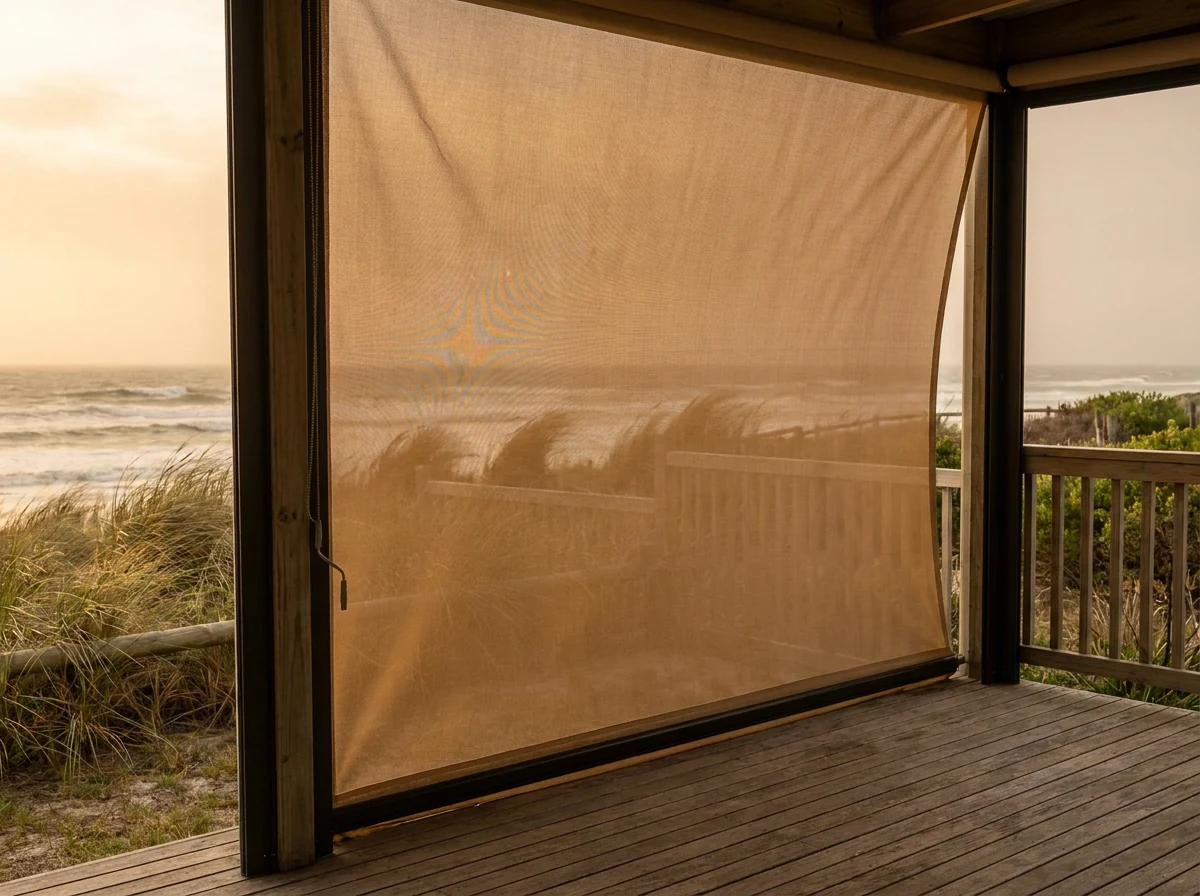
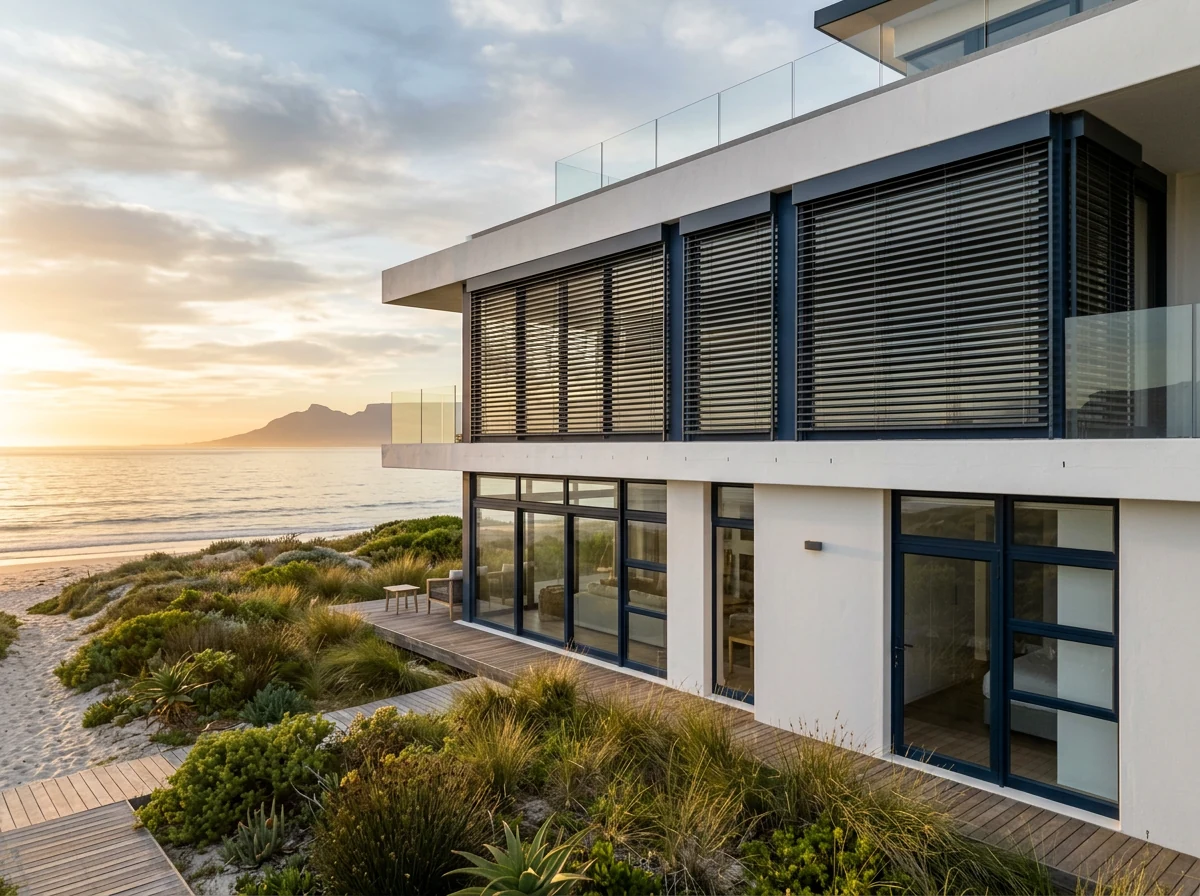
A zip screen doing the job it exists for. The grass behind it shows the wind; the fabric is not moving, because its edges are held in the channel.External venetians on an upper storey. Angle the slats and the low sun is stopped outside the pane while the sea stays visible beneath them.
04
The second row
One row back, the house in front of you has quietly become part of your specification. It takes the first bite out of the wind, and it catches a share of the sand before it reaches your tracks. The salt is still there — airborne salt travels a long way inland and does not need a strong wind to do it — but the mechanical punishment drops noticeably.
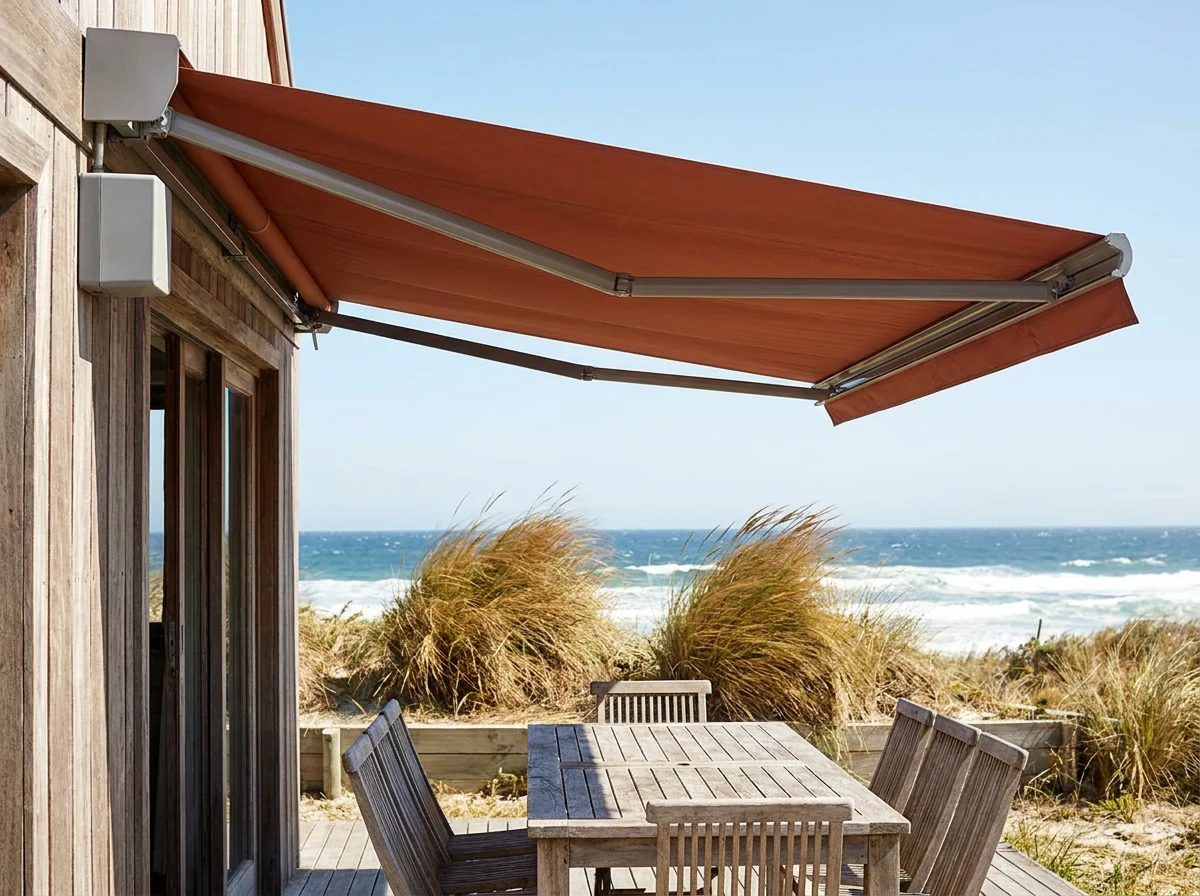
What that opens up is the folding-arm awning. On a first-row deck an extended awning is a large flexible surface with nothing holding its outer edge down, which is a hard ask. One row back, with a building upwind, it becomes a sensible product again: shade over the braai on demand, and gone in seconds when the June sun is something you want on the paving. It still gets a wind sensor. It still gets wound in when the south-easter really settles in. But it stops being the wrong choice.
Salt does not respect the second row
Corrosion engineers classify atmospheric aggressiveness in categories, and coastal and marine environments sit at the severe end of that scale — the point being that a coastal atmosphere is treated as a different design condition from an inland one, not a slightly worse version of it.4 In practice, for a blind or an awning, that means three things and no more:
Powder-coated marine-grade aluminium on anything mounted outside, and stainless fixings behind it. The coating is the entire defence, so a scratched bracket matters more than a scuffed fabric.
Sealed cassettes over open tubes, so there is less for salt and grit to settle into.
Fresh water over the outside hardware a few times a year. That is genuinely the whole schedule, and anyone claiming a coastal product needs none of it is selling rather than specifying.
The small box beside the cassette is the sensor. It is the reason a fabric arm is a reasonable product one row back from the dune.
05
Three streets back
By the third or fourth street the brief has changed character entirely. The wind is ordinary Cape wind rather than open-beach wind. Sand is a driveway nuisance rather than a hardware problem. And the house is usually a different animal too — the older single-storey cottage stock with small punched openings and shallow reveals, or a newer rebuild running a wall of glass toward a view of the sea that is now over a couple of rooftops.
Here the work moves indoors, and the questions become domestic ones:
The sunset room
Still sunscreen, still low openness, still on the west-facing glass — because the sunset does not care that you are inland. Where the same room must also go dark, the two fabrics can share a bracket — mesh on the outer tube, blockout on the inner — which ends the argument about which one you should have bought.
Bedrooms in an older cottage
Shallow reveals are the whole story. Every blockout fabric is opaque; what wakes you at five in the morning is the light down the sides. In a shallow frame there is often not enough depth to hide that with an inside fit, so the honest options are a face fit over the opening — darker, at the cost of covering the joinery — or an inside fit with side channels, which costs one more component and solves it properly.
Kitchens and bathrooms
Aluminium venetians, tilted rather than raised. They take steam and a wet cloth, they let you keep light over a sink without giving the street a view of it, and on a small cottage window they suit the proportions better than a roller does.
Cottage attics and gable glass
Converted roof space and raked gable glazing want a tensioned shaped or skylight system cut to the actual pitch. It is made to order, so it costs more and takes longer than a rectangle — worth knowing before the quote arrives rather than after.
Wide glass on a rebuild
Panel or vertical systems stack clear of a stacking door, which matters on an opening you walk through all day. One roller blind across four metres of unbroken fabric is a chain you will grow to dislike; we would split the opening or motorise it, and we will say so at the measure rather than after the fabric is cut.
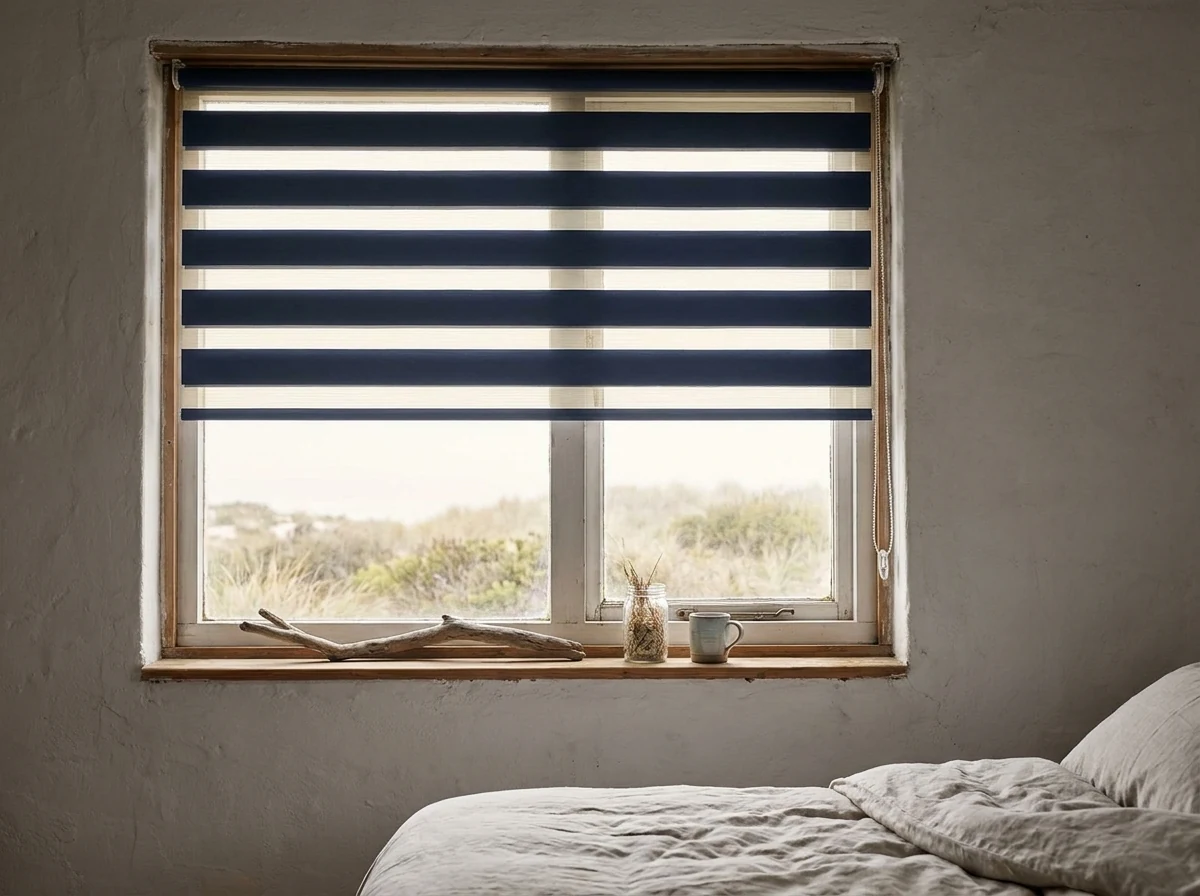
Banded fabric on a small cottage opening — slide the solid stripes into line and the window closes down without the bulk of a second blind.
06
The house that is empty on Tuesdays
A real share of this village is weekend and holiday property, and that changes a specification more than most people expect. A blind in a permanently occupied house has somebody to notice things. A blind in a house that is visited twice a month does not.
Three consequences worth planning for:
Nobody is home when the wind gets up. This is the strongest argument for wind-sensor motorisation anywhere on this coast — not convenience, but the fact that there is no one to wind the awning in on a Wednesday afternoon.
Ultraviolet keeps working in an empty room. Fading is cumulative and it does not pause between visits. On a west-facing lounge with good furniture in it, closing the blinds when you leave is worth more than any fabric upgrade.
An empty house that looks empty is its own problem. Timed or app-scheduled operation, so blinds move on an ordinary domestic pattern rather than sitting closed for a fortnight, is a genuine reason people choose motors here.
The honest limits: a battery tube motor needs charging once or twice a year and somebody has to be present to do it, which on a part-time house means planning it into a visit. Hard-wired motors avoid that entirely but want the cable planned before the wall is finished. And an app that depends on your home internet stops being an app the moment the router is off — worth deciding whether the schedule should live in the motor rather than in the cloud.
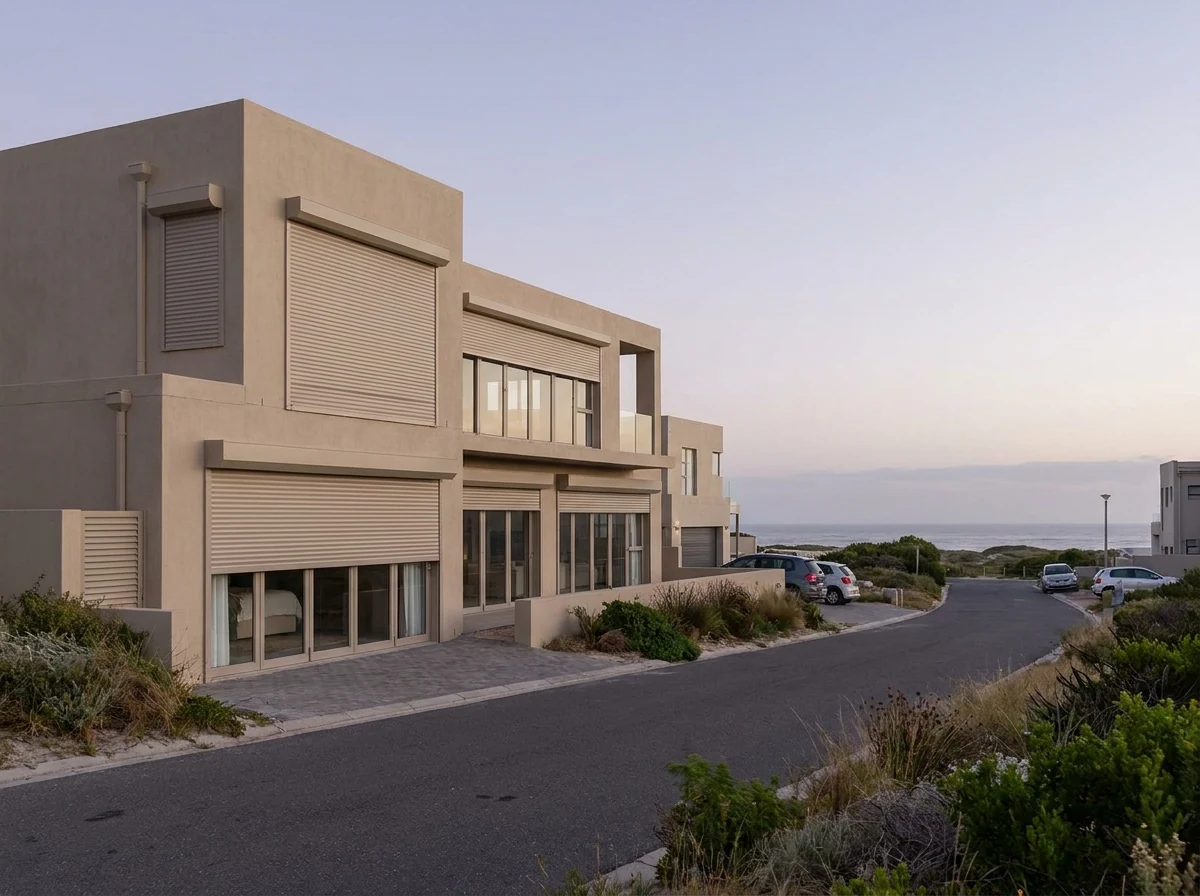
A house closed down between visits. Shutters do the shading, the darkening and the dust-keeping in one product, which is why part-time owners keep asking about them.
07
The five things we have to see
You can work out everything above from a street map. Not these five, and any one of them can move the recommendation:
Which row you are genuinely in. Not the street name — the sight line. A house with an open plot in front of it is a front-row house even if it is the third street back, and it gets specified that way.
Reveal depth, measured at three points. Older Melkbosstrand openings are seldom square, and fifteen millimetres decides whether a headbox fits inside the joinery or sits proud of it.
What the wall is made of. Solid masonry, cavity brick, or a light infill panel on a rebuild. What is behind the plaster sets the fixing, and occasionally rules an outside system out on that wall altogether.
The true bearing of each room. Houses here are frequently turned toward the water rather than square to the road, and everything in section two depends on getting that right.
Power, and who is around. Whether there is a socket near the head of the window, how a battery gets recharged in a house nobody is living in, and who will be there to do it.
None of the five can be settled over the phone, which is exactly why a consultant drives out and exactly why there is no charge for it.
Tell us roughly how far back from the beach you are and which room is the problem, and one of our expert consultants will contact you shortly to arrange your free in-home measure.
→
No call-centre hold music
A real consultant calls you back to arrange a time that suits your Melkbosstrand property.
→
Measured before it is priced
A quote follows the visit to the house. We do not guess sizes down a phone line.
Working out
Where the facts came from
Every geographic and climate claim above traces to one of these. Where a figure was calculated rather than quoted, we have said so rather than dressing it up as a measurement.
Melkbosstrand, Wikipedia — coordinates 33°43′52″S 18°26′31″E; roughly 30 km north of Cape Town, between Bloubergstrand and Atlantis; a seven-kilometre white sand beach; a population of 11,586 across 35.64 km²; the Blouberg hill rising to the east; and the nature-conservation area to the south and buffer zone to the north that keep the village low and open. en.wikipedia.org/wiki/Melkbosstrand
Solar geometry — calculated, not cited. Every angle in section two comes out of Melkbosstrand's latitude of 33.72° S and the earth's 23.4° axial tilt, worked by hand. They are properties of this line of latitude, and no instrument in the village was consulted to obtain them.
The Cape Doctor — the summer south-easterly, a fixture on this coast from about October until March and hardest in the two months either side of Christmas; the reason exterior products here are specified around gusts rather than averages. capetownmagazine.com/cape-doctor
Atmospheric corrosivity categories — the international convention (ISO 9223) of classifying an atmosphere's aggressiveness toward metals, in which coastal and marine environments fall at the severe end of the scale. We cite it for the principle that a coastal atmosphere is a different design condition from an inland one; we have not measured a corrosion rate in Melkbosstrand and do not claim one.
Gusts against sustained wind. That short gusts run materially above the sustained wind speed over open ground is standard meteorological practice rather than a local measurement, which is why this guide argues for an automatic retract instead of quoting a headline figure.
The specification advice above is ours, offered without charge and without obligation. Approvals of any kind — municipal or body corporate — are made by other people, and we would not pretend otherwise.
Get your Melkbosstrand windows measured
Free in-home measure, a full written quote, no obligation.